Riley, Rice Marsh, and Hyland lakes removed from impaired waters list
The Riley Purgatory Bluff Creek Watershed District is excited to announce the delistings of Riley, Rice Marsh, and Hyland lakes from the impaired waters list!
The Minnesota Pollution Control Agency (MPCA) maintains an impaired waters list as required by the federal Clean Water Act. These three lakes were on the list due to an excess of nutrients such as phosphorus. After projects implemented by the District and its partners, these lakes now meet state water quality standards. Read below to learn more about the work that was done.
The following excerpt is from an article from the Minnesota Board of Waters and Soil Resources (BWSR) newsletter about work that was done to help get Lake Riley and Rice Marsh Lake delisted.

Riley Purgatory Bluff Watershed District:
Rice Marsh Lake, Lake Riley
Read the full article in BWSR 2026 July Snapshots, which highlights water quality projects installed with support from BWSR Clean Water Funds.
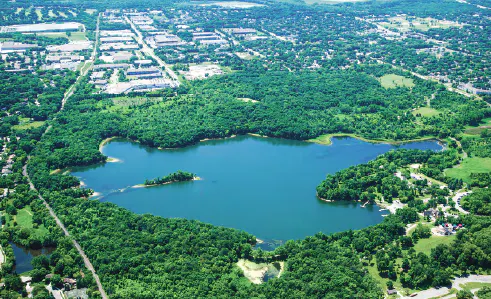
A shallow lake that was a spawning area for common carp from Lake Riley until a barrier was installed, 83-acre Rice Marsh Lake lies within Chanhassen and Eden Prairie, surrounded by a park that shares its name. With an average depth of 5 feet, the lake attracts birdwatchers and paddlers.
Anglers and water-skiers are among those drawn to Lake Riley, a heavily used recreational lake with public water access and a (temporarily closed) swimming beach in the adjacent park that shares its name. It, too, straddles the Chanhassen-Eden Prairie boundary. Residential development lines its shores to the south and west. The 297-acre lake’s average depth is 23 feet.
Both lakes were listed as impaired for aquatic recreation because of excess nutrients — Rice Marsh Lake in 2018, Lake Riley in 2002.
“We’ve seen significant improvements in water clarity in both those lakes. We have seen a significant decline in total phosphorus and the typical chemical parameters,” said Terry Jeffery, Riley Purgatory Bluff Creek Watershed District (RPBCWD) administrator.
Clean Water Fund-supported projects upstream contributed to those water-quality improvements. A $283,000 stormwater retrofit at St. Hubert Catholic Church and School drew $63,865 from a 2021 Metro Area WBIF award. Tree trenches, a rain garden and prairie plantings, impervious surface removal and gully repair were part of the work to treat stormwater that flowed to Rice Marsh Lake. The RPBCWD, Carver SWCD, the Metropolitan Council and St. Hubert’s provided matching funds and in-kind donations.

“We were treating a directly contributing watershed to Rice Marsh Lake. In addition, there was the sediment deposition from the eroded gully that was addressed for water quality and water clarity improvements,” Jeffery said.
Riley Creek connects Lake Susan, Rice Marsh Lake and Lake Riley. Upstream work affecting Lake Susan helped to improve water quality in the downstream lakes.
A $233,400 competitive Clean Water Fund grant BWSR awarded to RPBCWD in 2015 supported $574,000 in stormwater reuse enhancements and treatment within the Lake Susan watershed (excluding engineering costs). The watershed district provided the match. Previously, stormwater from the Chanhassen business district drained to an under-sized pond in Lake Susan Park. The project installed a two-stage pump to irrigate ballfields and pump water into an ironenhanced sand filter before it entered Lake Susan.
“They (Clean Water Funds) are imperative to us being able to do our work,” Jeffery said. “Without it, the amount of work we can do is limited to what we can levy. As project costs (increase) and the political climate for levy increases declines, that means less and less that we can do without some type of financial assistance.”

Rice Marsh Lake has met the shallow-lake water quality standard for clarity for the past 17 years. It has met the standard for phosphorus five of the past eight years. Alum treatments in 2018 and 2025 followed work to curb phosphorus-loading from the area draining to the lake. And it met the Chlorophyll-a standard for eight of the past 10 years.
Lake Riley has met the deep-lake standard for clarity for 12 years, phosphorus for 10 years (following alum treatments in 2016 and 2020), and Chlorophyll-a for seven of the past 10 years.